
Senior United States lawmakers told a Capitol Hill conference that India was crucial for stability in Afghanistan and the region as US and North Atlantic Treaty Organization forces prepare to withdraw from that war ravaged country.
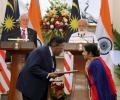
Considering the common linkages, high-level trust, complementarities, and convergent interests between the two nations, Malaysia has the potential to become India's key partner in Southeast Asia, says Dr Rahul Mishra.

Asserting that there are terror groups that are instruments of state's policy, Prime Minister Narendra Modi said terrorism uses diverse motivations cannot be justified.

'In the past the US has been reluctant to name Pakistan directly in an US-India joint statement.'

The South Carolina governor has become the first woman and minority to join Trump's administration.

All international passengers will henceforth be screened at airports, Health Minister Harsh Vardhan said at a press conference. Earlier, travellers from only 12 countries were screened at airports for the disease that has claimed over 3,000 lives and infected more than 90,000 worldwide.
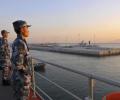
China released a white paper against the UN-backed tribunal's verdict, insisting that Beijing has claims over the strategic region for 2,000 years.

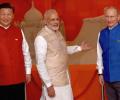
'Xi Jinping got a dose of Modi's medicine inside the tent where he was being hosted on the banks of the Sabarmati river.' 'Modi reportedly told him, looking deep into his eyes: "This was not expected of your country. Can you tell me when the troops are withdrawing?".'

To be at Kakkathuruthu when the sun sets, according to National Geographic, is a surreal experience. Ambassador T P Sreenivasan tells us how the tiny island gradually charmed him.

'Look East' policy was first coined by the Narasimha Rao government in the 1990s and has been followed by the successive governments.
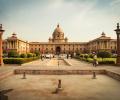
New Delhi bureaucrats, accustomed to leisurely lunches, golf in the afternoon and long weekends, have been shaken out of their somnolence, say authors. Fear and suspicion hang heavy over the red-sands.
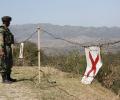
'The response to terror is not always reciprocal terror, nor is launching a conventional response the best response.' 'The best response is to make the sponsor pay a price he cannot afford,' says former RA&W chief Vikram Sood.

'Engagement should never stop.' 'Reassure Kashmiris that they will be treated at par with the rest of India.' 'The peace you crave will be peace with honour.' 'Your special status will not be tinkered with.'

'Make in India' will be central to Mr Modi's visit to Europe and Canada. It is difficult to predict what will happen with the Rafale deal, but if it goes through, it will undoubtedly become the 'Mother' of all 'Make in India' projects,' says Claude Arpi.
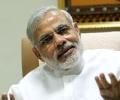
Wisner said during a discussion organised by Asia Society here yesterday on the Indian elections.

'These ISIS terrorists want to smash Western civilisation, smash India. For the time being though, their main target would be the US and Europe.'

Srikanth Kondapalli on what to expect from the seventh BRICS summit meeting to be held in Russia in July.

'For its part, Pakistan often gives safe haven to agents of chaos, violence, and terror.'

Prime Minister Narendra Modi has done the seemingly impossible by finalising the long-pending Land Boundary Agreement ahead of his Bangladesh visit, writes Prakash Bhandari.

Terrorism and Afghanistan were the focus points of Prime Minister Narendra Modi's talks with Uzbek President Islam Karimov on his first visit to Central Asia.

'The ISI has given a stunning display of its capacity to do with impunity what it likes within Kabul. Incensed over the triumphalism of the hardliners in Kabul, the ISI has hit out; it is a typical ISI reflex action that Indians are familiar with,' says Ambassador M K Bhadrakumar.

A secret document provided by National Security Agency whistleblower Edward Snowden reveals that only 1 billion of the 1.35 intercepts that the US snooped on are terror related, the rest a breach of privacy. Vicky Nanjappa reports

'The combination of the LeT and the ISI is the most dangerous terrorist challenge in the world because it carries a real and present danger of provoking nuclear war.'

The US needs to do three things to help the newly elected Nawaz Sharif government in Pakistan, says Stanley A Weiss
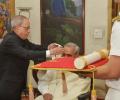
Former PM Atal Bihari Vajpayee was on Friday conferred with the Bharat Ratna.

India will be informing Sri Lanka about an official working with the Pakistan High Commission in Colombo who was allegedly playing a key role in planning terror strikes at the behest of ISI on the US and Israeli consulates in the southern part of this country.
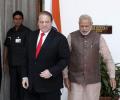
India'Prime Minister Narendra Modi has been congratulated for his speedy diplomacy and his talks with Pakistani counterpart Nawaz Sharif. However, academic Christine Fair and former Pakistan ambassador to US Husain Haqqani dismiss the meeting, calling it merely a photo-op and an exercise in futility. Aziz Haniffa reports.

PM Modi addressed a crowded UNESCO gathering, speaking of the importance of culture.
'With Pakistan's 'first use doctrine' threatening the use of nuclear weapons early in a war with India, the S-400 will shield vulnerable targets like Delhi and Mumbai, complicating Pakistan's targeting calculations.'
Humanitarian intervention has little meaning unless the international community is willing to engage in the aftermath, says Shyam Saran.
'If we play our cards right, we may even benefit from the competition between the US and China as seen from increased investment from each of these countries into India.' 'The size of our market gives us an important lever of power which we shall have to play adroitly and intelligently,' points out Ambassador Gautam Bambawale -- who served as India's envoy to China -- in the Professor V M Dandekar Memorial Lecture 2019, delivered on March 8, 2019 in Pune.

'It is in the interest of both sides that the visit of the US President is seen as being successful. Both sides have invested considerable political capital in it. This rapid exchange of visits and the decisions taken have to be justified, beyond the symbolism, which is no doubt important in itself. This opportunity to impart a fresh momentum to ties should not be missed,' says former foreign secretary Kanwal Sibal.

India has no compelling reason to grant his request for asylum but was unduly inhibited in raising its voice against the United States' extensive and vulgar intrusion into the privacy of its institutions and citizens, says Shyam Saran
Sushma Swaraj, like Clinton, has a strong political base in her own party and is likely to have her imprint on foreign policy, says Ambassador T P Sreenivasan.

'If the Americans believed that India is as strong as China or Russia, would they have shown this scant respect for us,' asks Tarun Vijay, MP. 'An economically strong and militarily powerful India would never have had this experience. Not just the Americans, everyone in this world respects might. China receives respect, India gets the law book.'

Thiruvananthapuram did not give him a resounding victory, but did not abandon him either. If he learns his lessons and avoids the pitfalls of the past, he will have a bright political future, says T P Sreenivasan.

Incoming US President Donald Trump has assembled a core team that is -- not surprisingly -- overwhelmingly white and male.

The White House said it has 'a large body' of evidence indicating that the Assad regime was responsible for the April 7 chemical attack in Duma.

Over the last four days, Prime Minister Narendra Modi greeted the heads of over 50 African nations, some of whom have extremely unsavoury reputations. Meet the 10 most controversial leaders who visited Delhi this week.

Meet the US Attorney who took on Donald Trump.
 © 2026 Rediff.com - Advertise with us - Disclaimer - Privacy Policy - Sitemap - Feedback - About us - Terms of use - Grievances